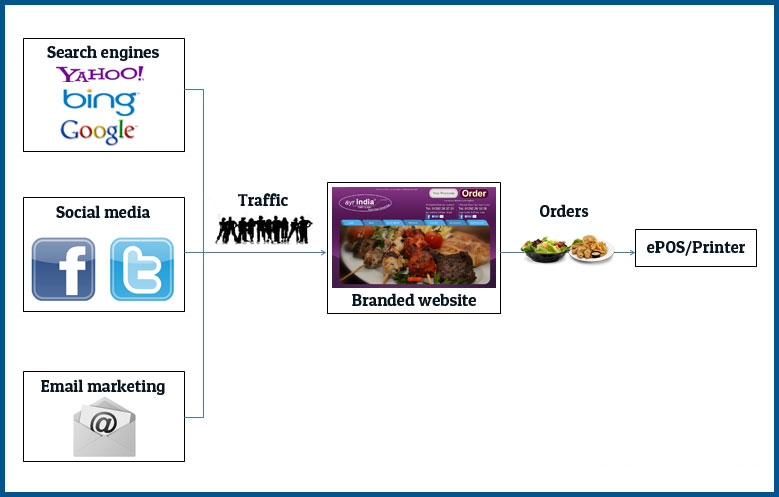
Restaurant EPOS systems have become a necessity. Today’s craze for ordering food over the internet for delivery or takeaway changed the whole way of doing the business. Although this shift in business offers considerable revenue opportunities, not having a robust system to manage these channels can make their management give a variety of operational headaches. Orders placed outside of a restaurant EPOS system usually lead to inefficiency, errors, and decreased customer satisfaction.
Below are some key challenges that arise whenever delivery and takeaway operations are not integrated into the EPOS system of a restaurant.

A. Mistakes in Manual Input
For restaurants that receive orders for takeaway through third-party platforms like Uber Eats, DoorDash, or directly over the phone, there is often manual entry of such orders into the internal restaurant EPOS system. The allowance for manual input leaves room for mistakes such as:
- Order Missing Details: In the absence of automation, there is a possibility of entering wrong items, quantity, or customization in the system, thereby resulting in customers receiving erroneous orders.
- Human Error due to Volume: During high volumes, it is tempting to rush through the data input. A forgotten ingredient or an incorrectly taken order detail may be just a minor oversight for the employee, but it is an important detail for the customer.
- Inefficient workflow: The facility has to write down each order received from the third-party platforms by hand, for which they lose a lot of time. Instead of focusing on getting the food ready or dealing with in-house customers, staff have to spend some portion of their time transferring order data into the system, thus inviting errors and delays.
These mistakes, other than delaying service, dent the reputation of any eatery as well. Negative customer experiences because of such mistakes are shared on review platforms, which in the long run could amount to lost business.

B. Order Processing Inefficiency
Actually, any restaurant, whatever the size, faces operational challenges related to manually keeping track of delivery and takeaway orders in high numbers. No integration of restaurant EPOS forces the kitchen and staff to juggle several streams of orders simultaneously. Some specific inefficiencies in this regard include:
- Duplicate Efforts: While operating a restaurant for dine-in and takeaway service, staff have to maintain two different order management systems-one for dine-in and another for the orders on delivery. This leads to duplication of efforts and, of course, it wastes unnecessary time managing the orders.
- Delayed Order Processing: This is because the staff has to manually transfer information from the delivery platforms to their internal system, which causes delays. This may lead to a longer waiting period for both delivery drivers and customers, causing them to give bad reviews and complain.
Lack of clarity with regard to prioritization: Without clear visibility of all orders within one system, it is much more difficult for staff to prioritize which orders to make first. This leads to missed deadlines on deliveries, longer wait times for customers of takeaway, and disorganization in the overall kitchen.
Efficient order taking is crucial to the success of your restaurant, particularly during peak periods. The faster and more accurately your restaurant can process delivery and takeaway orders, the more orders it can fulfill, and the more money it can make.

C. Disconnected Systems and Data Silos
The major drawbacks of not integrating delivery and takeaway orders within a restaurant EPOS system include the inability to sync real-time data. If the orders routed via third-party platforms like Uber Eats, Just Eat, and Deliveroo are not automatically synced with the in-house restaurant EPOS, that creates discontinuity in the operational flow.
- Poor inventory management: A restaurant which does not integrate delivery orders through its restaurant EPOS will face some discrepancies in stock. For example, certain menu items may get sold out through in-house dining, but without automatic updating on the delivery platforms, customers will still be able to place orders online for that menu item. The consequences are cancellations, refunds, and disgruntled customers.
- Reduced visibility or trackability of sales performance: Processing delivery orders outside of the restaurant EPOS makes it very difficult to report on and analyze the performance of each sales channel. Without that centralized data, restaurants don’t have key insights into customer behaviors, peak order times, and popular items across the in-house and delivery channels.
Restaurant EPOS systems, such as eTakeawayMax, also have the benefit of simplifying complex accounting and reconciliation. This means that the accounting team does not have to do the reconciliation manually from sales data recorded in a separate system, hence making it less time-consuming with low chances of human errors. Having disconnected restaurant EPOS systems can make it hard for a restaurant to compute taxes, tips, and commissions on delivery platforms.
Data silos hinder the restaurant’s ability to function efficiently, predict demand accurately, and smoothen day-to-day operations.

The Cost of Staying Disconnected
Without the integration of orders for delivery and takeaway into the central restaurant EPOS system, there is a tendency for inefficiency and error that eventually hurt the business negatively. Manual entry is prone to errors; delays in processing hurt customer satisfaction while the lack of one centralized system creates silos that negatively affect inventory management and financial tracking.
Disconnectedness is expensive in today’s competitive market, with high customer expectations involving not just time and labor but also revenue and customer loyalty. Investment in an integrated EPOS system-one that combines delivery and takeaway services for any agile, efficient, and competitive restaurant-is quite vital.
Upgrade your restaurant’s POS system today with eTakeawayMax and set your business on the path to greater efficiency and success!
Start your completely risk-free 90 day trial today.